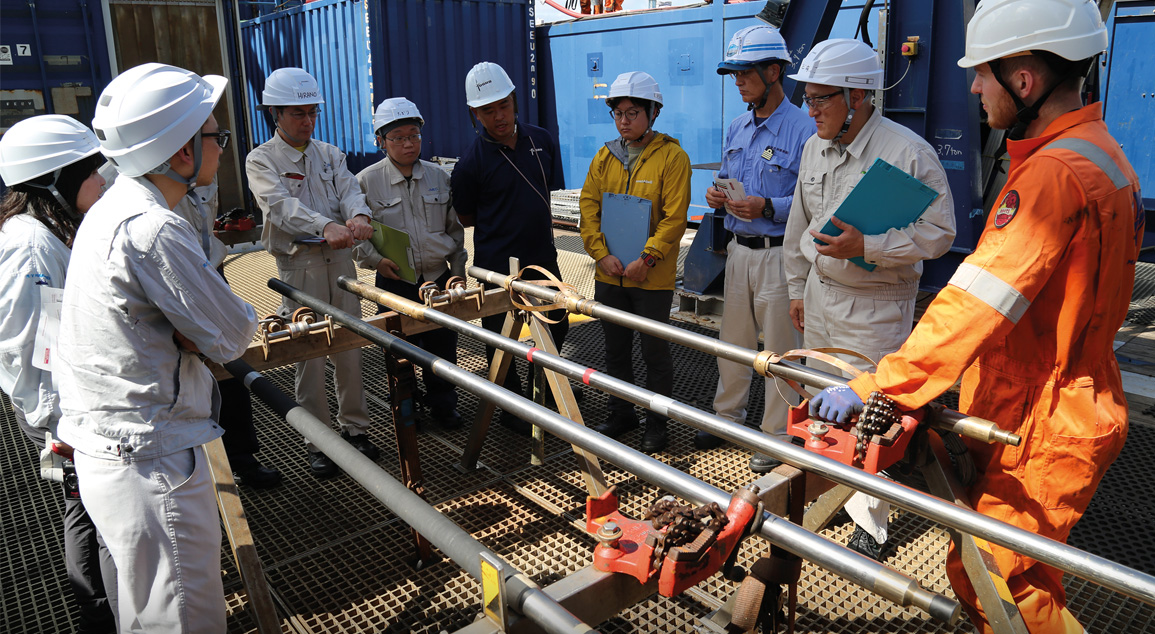
Robertson Geo Services (RGS) were contracted through parent company OYO Corporation to carry out borehole logging for JOGMEC (Japanese Organization for Metals and Energy Security) on deep-sea boreholes in the Okinawa trough, to help quantify massive sulphide mounds containing mineral deposits of copper, lead, zinc, gold and silver.
Among Japan’s southern islands lies the remains of ancient hydrothermal vents on the seafloor around which these deposits can be found. Current estimates put deposits in this location at around 51 million tons.
High Resolution Acoustic Televiewer (HRAT)®, Electric Log, Dual Induction and Small Source Density probes were run on three boreholes at water depths of more than 1,000m, conveyed by a Robertson Geo 2,000m Marine Winch. Specialised versions of the probes were used due to the potential for high temperature and all probes underwent calibration and conformance checking prior to deployment on the heave compensated drill vessel.
The main operational challenge was to regain access to the previously drilled boreholes. A state-of-the-art ROV, with high resolution image capability, was deployed down to the seabed to provide visual feedback so the vessel could position itself precisely. Once the drill bit had gained access to the borehole the vessel maintained its position with an automated system. The borehole was then checked and the casing withdrawn near to the top of the borehole, allowing logging operations to commence.
Heave compensation for the winch line was achieved by securely mounting the winch on the rooster box and running the wireline through a sheave wheel connected to a davit arm. All equipment and probes were surface tested before operations commenced and depth was referenced using seabed as a datum. The Electric Log was run first to monitor temperature, followed by the other probes.
The complex operations were conducted safely throughout and the wireline data collected suggested a correlation with earlier data from core samples.


