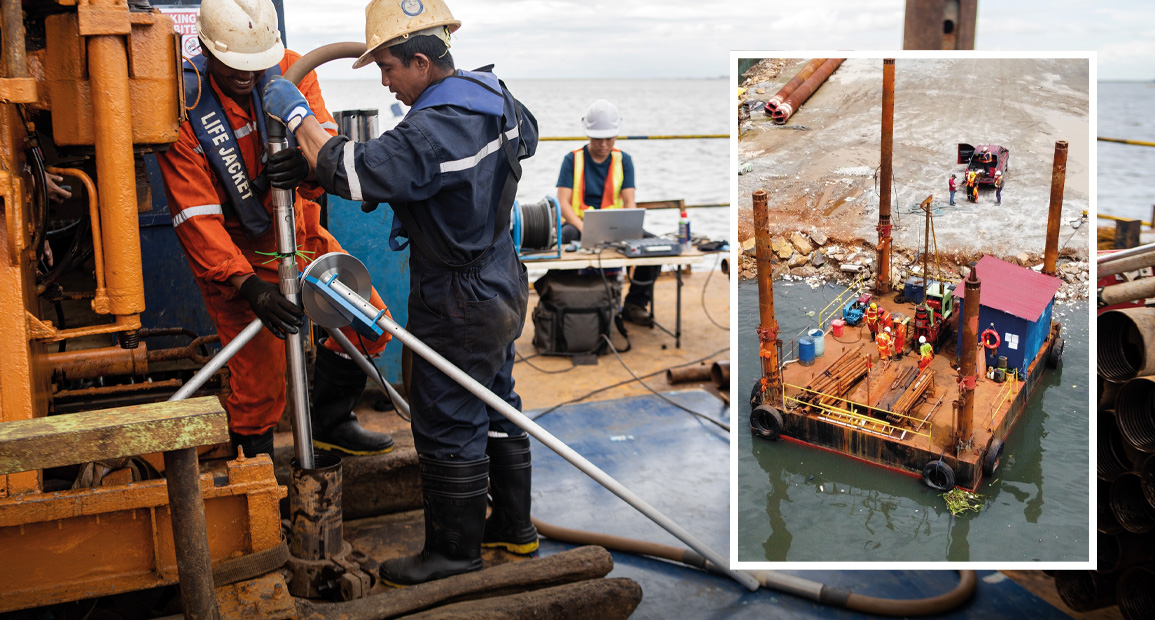
The logging determined the dynamic properties of the foundation soils and/or rocks. The analyses of the test was done to determine the following dynamic soil/rock properties:
• Elastic Moduli • Poisson’s ratio • Vp and Vs profiles
With the site area located in a relatively shallow water environment (1 to 10m of water), Robertson Geo client Sol Roche used jack up pontoons as a stable platform in which to conduct the PS Suspension Logging. The Robertson Geo PS Logger® probe was deployed using a surface winch with the data being compiled via the Micrologger2, the surface interface system for data acquisition. The PS Logger® is a full waveform acoustic probe, designed to measure compressional and shear wave velocities in soils and rock formations. It operates using indirect excitation rather than mode conversion as in a conventional sonic.
The logging was part of the Geotechnical Investigation package of Sol Roche Geotechnical Consultancy Corporation for the project which included boreholes and undisturbed sampling, Field Vane Shear test and (seismic) Cone Penetration test.
The residual soil layer was characterised by very stiff to hard, dark brownish grey to light brown, sandy to silty clay. It is made of the in-situ weathering and alteration of volcanic ash/tuff as evidenced by the preservation of the relic vesicular texture. Some samples belonging to this layer showed altered/weathered breccia and agglomerates appearance with clasts made up mainly of scoria and glass fragments. Being residual soil in nature, transition to highly weathered and highly fractured brown to brownish grey siltstone appearing as rock fragments.
The weathered rock layers of the Guadalupe Formation is made of:
SANDSTONE (Lappillistone and Lappilli Tuff): Very weak to weak, brownish grey to dark brownish grey, mottled in some parts, silty fine to coarse sandstone. Some parts are highly weathered and highly fractured.
SILTSTONE/CLAYSTONE (altered Volcanic Tuff): Very weak to weak light brown to brown, occasionally brownish grey tuff. Highly weathered and grading to residual soil in some parts.
CONGLOMERATE (Breccia and Agglomerates): Very weak to weak, mottled light brownish grey and dark grey conglomerate. The clasts are made up of sub angular to sub rounded scoria, andesite and basalt fragments embedded in a tuffaceous matrix.
Each distinct layer represents different episodes of pyroclastic emplacement/deposition.


