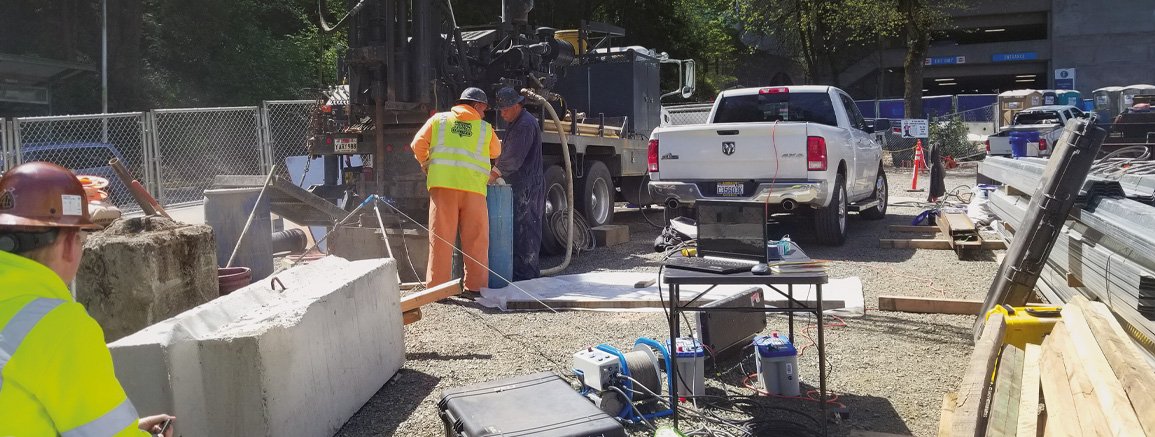
In particular, the explosive economic growth in Seattle has led to an ever-increasing density of towering buildings being erected at a breakneck pace, as well as the transit infrastructure that is needed to support them. The PS Logger® has become a go-to probe for geotechnical testing in these areas of high earthquake susceptibility where concerns exist over the next “big one”.
The PS Logger® was developed in 1979 in Japan by the OYO Corporation for earthquake engineering with development, manufacture and distribution being managed by Robertson Geo since 2010. The PS Logger® is designed to measure shear and compressional wave velocities in hard formations and in soft unconsolidated formations from a single borehole.
In Situ Engineering acquired the PS Logger® over three years ago and since then it has seen near constant field deployment on a variety of projects from large scale dam design, bridge replacements, mass transit projects, below water foundation designs, and new and old high-rise buildings. States like Washington and Oregon are at the forefront in requiring seismic geotechnical testing on nearly all major infrastructure projects and the Robertson Geo PS Logger® has performed well, enabling In Situ Engineering to meet the requirements of project mandates.
For In Situ Engineering the PS Logger® can be used alongside other downhole geotechnical testing services such as the electronic pressure meter to maximize the amount of data a single borehole can give. This can save a project time and money by reducing the amount of drilling needed and increasing the efficiency of testing from a single mobilization.