Ice shelves are the floating extension of ice sheets that reach the ocean, holding back the land-based glaciers that feed them and losing mass through iceberg calving caused by the opening of large cracks or rifts. Such icebergs can be sizable , e.g. Iceberg A-68, which calved off Larsen C Ice Shelf in July 2017, was a quarter of the size of Wales. In extreme cases, rift propagation can lead to ice shelf disintegration (e.g., Larsen A in 1995 and Larsen B in 2002). The response of land-based ice to the loss of buttressing ice shelves is a large uncertainty in projections of Antarctic ice mass loss and sea-level rise.
Antarctic ice shelves are not materially homogeneous; instead they are formed of alternating flow-parallel bands of cold, hard ‘meteoric’ ice supplied from inland glaciers, and warm, soft ‘suture zone’ ice, formed by ice accretion onto the ice shelf base in the ocean cavity below. While rifts travel quickly through meteoric ice, they are halted (temporarily or permanently) in suture zone bands. Despite this important role, little is known about either the material properties or the mechanical processes involved in rift propagation. One of the RiPIce project aims was therefore to characterise the physical properties of the suture zone ice and its impact on rift propagation.
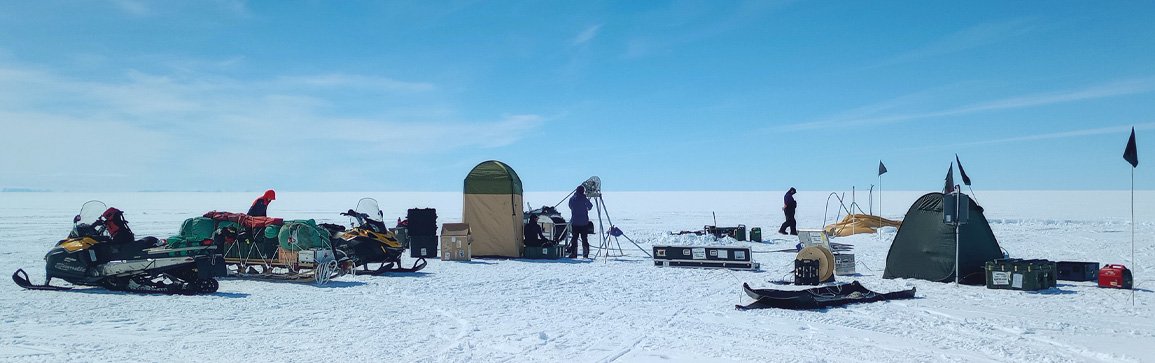
In December 2022, three boreholes were drilled by hot-water into Larsen C Ice Shelf, Antarctica – two into a suture zone band and one into a meteoric ice band. One suture zone borehole was logged to 120m depth with the RGeoEye®, High Resolution Optical Televiewer (Hi-OPTV)®, Electric Log, and Full Waveform Triple Sonic probes, with the intention of characterising the ice properties as fully as possible. The meteoric ice borehole was logged to 160m depth with the Hi-OPTV®.
Working in the Antarctic is always challenging not least because, even in the Antarctic summer (December), air temperatures are typically sub-zero putting pressure on both equipment and staff safety. Variable borehole width due to layers of differing ice density in the upper ice shelf, meant that some probes couldn’t be centralized. As soon as drilling finished, the boreholes began to refreeze, so the challenge was to log the borehole with all the probes before refreezing meant that one could get stuck!
The Robertson Geo equipment used to log the boreholes comprised: RGeo-eye® downhole camera, High Resolution Optical Televiewer (Hi-OPTV)®, Electric Log, Full Waveform Triple Sonic, 600m Winch and Micrologger 2.
Image courtesy of Dr. Katie Miles


