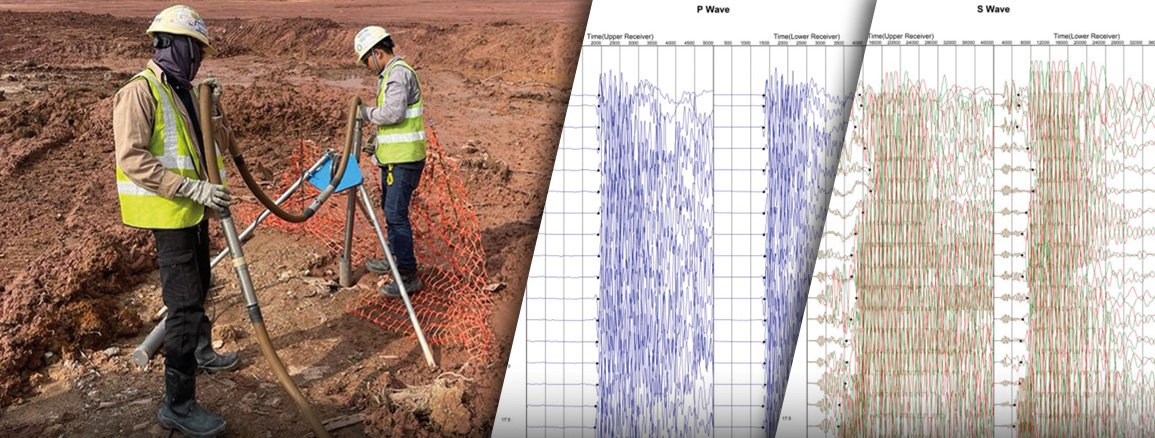
To ensure the safety and stability of building construction in Singapore, it is crucial to have a thorough understanding of the local soil conditions. Local authorities propose downhole P and S velocity data determination to obtain detailed information about the soil profile.
This data is essential for developing appropriate construction protocols that comply with Eurocode 8 seismic stability requirements. Eurocode 8 provides specific guidelines for classifying soil types based on their seismic response. The classification system relies heavily on shear wave velocity (Vs30), which is the average shear wave velocity in the top 30 meters of the soil. The classification ranges from “Type A” (rock or very stiff soil, where Vs > 800 m/s) to “Type E” (soft soil, where Vs < 180 m/s).
This classification allows engineers to factor in site-specific ground motions when designing structures. By classifying the ground type according to Eurocode 8, engineers can accurately assess the seismic hazard and design building foundations that can withstand potential earthquakes in the country.
A more traditional downhole seismic method was initially considered for its potential to provide detailed insights into the subsurface conditions but proved inadequate for obtaining accurate and reliable soil profile data at depths exceeding 10 meters due to technical limitations and reduced signal quality.
Recognising the need for a more effective approach to capture comprehensive data from deeper soil layers, the decision was made to transition to the suspension PS logging technique. This method, known for its enhanced sensitivity and ability to deliver higher-resolution measurements across a wider range of depths, successfully overcame the challenges faced with the downhole technique.
The Robertson Geo PS Logger® provided the precise and detailed seismic velocity profiles necessary for a thorough understanding of the soil’s mechanical properties at greater depths. As a result, the client was able to establish robust building construction protocols that not only complied with seismic stability requirements but also ensured long-term safety and resilience against potential environmental hazards. This transition significantly improved the accuracy of the data, facilitating informed engineering decisions and ultimately contributing to the success of the construction project.


