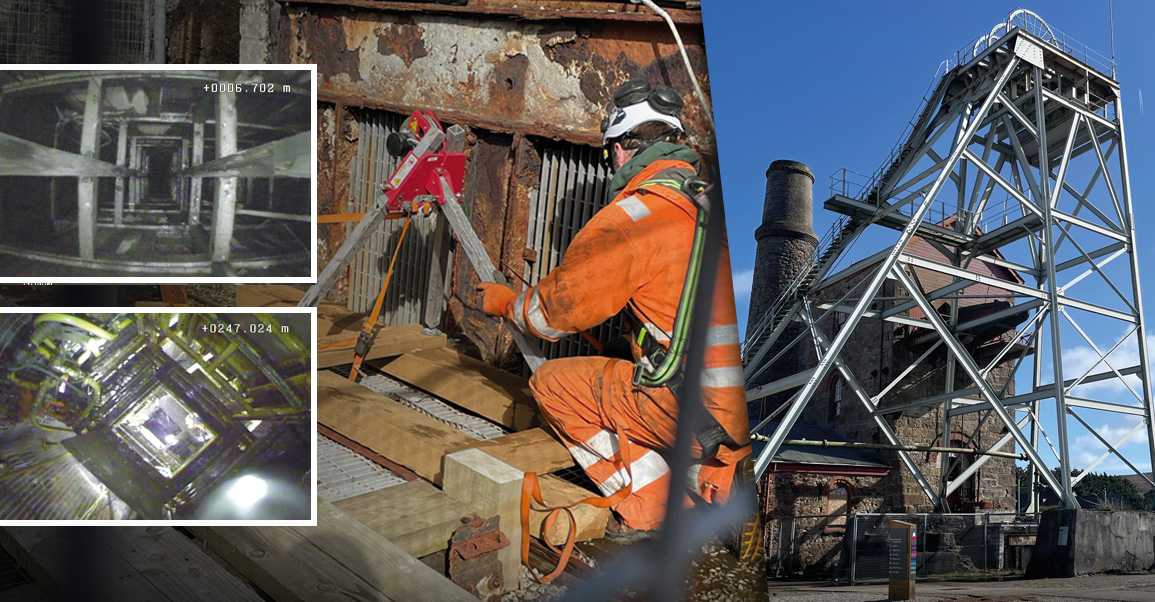
Cornish Metals is now working towards dewatering and re-opening the historic South Crofty underground tin mine, considered as a strategic tin asset. The aim of this survey was to confirm the integrity of the shafts, scheduled for refurbishment for ventilation and hoisting purposes.
Each shaft required a unique approach for the logging setup, as the access for each was quite different. Two of the sites required the RGS engineers to wear harnesses for safety reasons.
Taylor’s Shaft had been inspected previously and was re-visited to confirm the shaft condition as part of plans for its re-use. This 520m deep shaft served both East Pool mine and later the South Crofty mine. Tin mining started in the early 18th century and production continued until 1998.
Robinson’s Shaft is a rather unusual shaft because unlike the common rectangular forms, this has a circular plan with a circular blast made of granite rubble. Bought by South Crofty Mine in 1902, a new engine house was built in 1903 and the engine pumped water for the next 50 years.
New Cooks Kitchen Shaft is a working shaft some 770m deep. Surveying this shaft required an engineer to wear the required safety gear and enter the shaft with the banksmen, to align the tool using two bottom sheaves.
Roskear Shaft was considered as a replacement for Robinson’s Shaft. The shaft was started in 1923 and completed to 610m deep by 1926. In 1962 the South Crofty Mine began to use Roskear Shaft as an up-cast ventilation shaft. A large electric fan was installed to improve the ventilation, which dropped the temperature and improved the air quality. The Roskear shaft was then equipped with a new headframe and winder for emergency egress purposes.
The CCTV camera used was the Robertson Geo Downhole Camera with side and bottom view capability. This can produce clear images, in both air and underwater in large diameter shafts. For this application, additional lights were fitted onto a pipe which slides on to the tool, resulting in clear and bright videos.
CCTV camera surveys are a prime requirement for shaft investigations, clearly showing the condition of the shaft walls and floor. The videos obtained are recorded for subsequent detailed inspection and form a permanent record of the structural condition of shafts.


