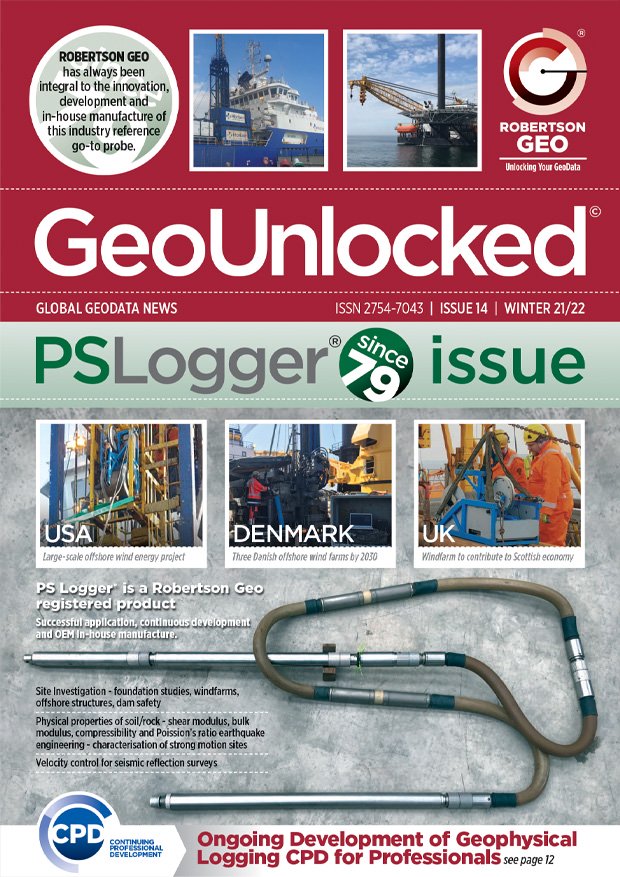
Products
The PS Logger® probe has been used to accurately measure P and S wave velocities in boreholes since 1979, now achieving prominence as the industry reference go to probe for the determination of soil and rock strength in offshore wind farm development.
Recording full waveform data across six channels, the PS Logger® is an acoustic probe designed to measure compressional and shear wave velocities in soils and rock formations. It operates using indirect excitation rather than mode conversion as in a conventional sonic probe.
Developed and manufactured under an ISO9001 framework, exclusively by Robertson Geo, the PS Logger® is available as a full turnkey service, for rental or for outright purchase with full training provided.

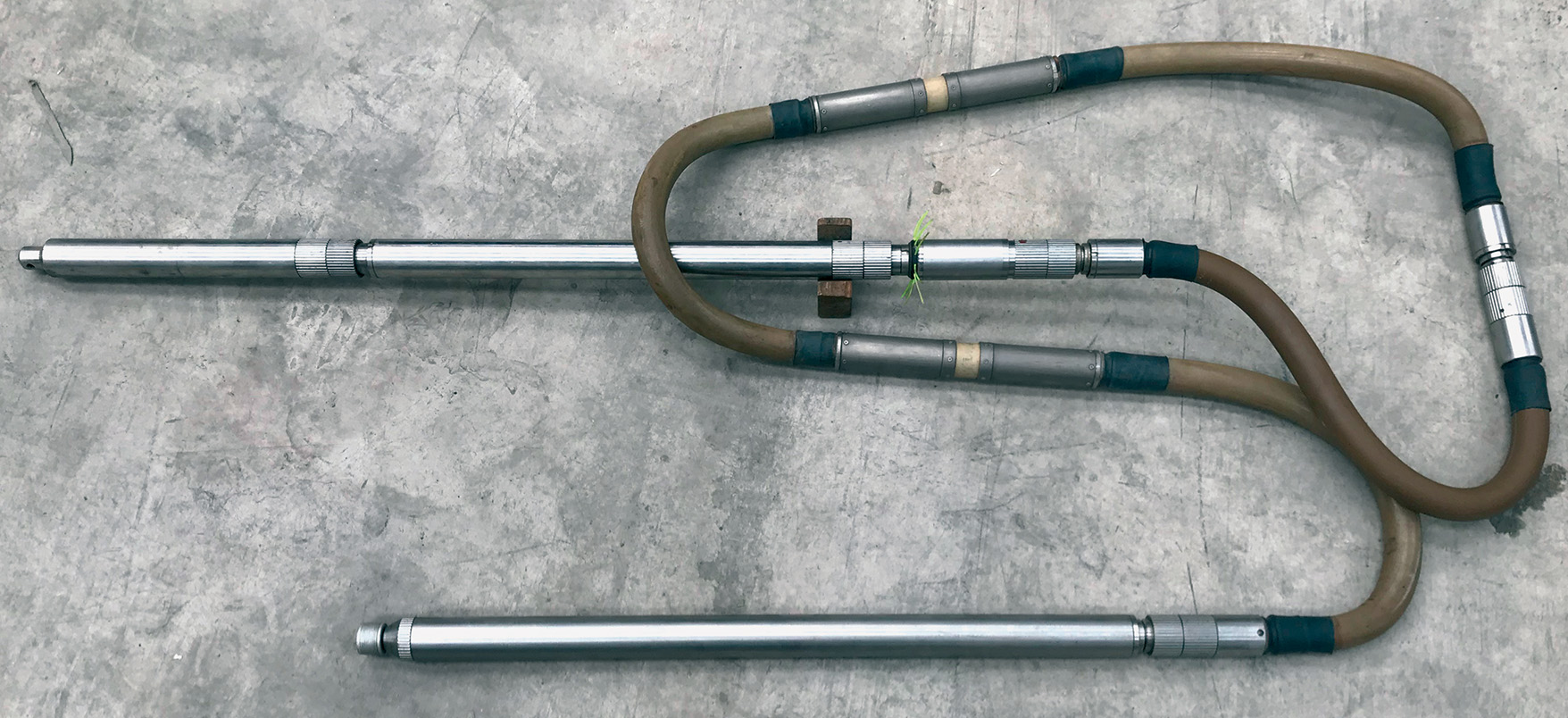
The PS Logger® is a dipole tool, unique amongst sonic logging tools, determining P and S wave velocities from a single borehole without the need for an external source. Excellent shear wave velocity data can be achieved from the PS Logger® across a spectrum of strata from unconsolidated sediments to the hardest of rocks. With minimal borehole preparation required and a high tolerance to surface noise the PS Logger® has become an industry reference method for subsurface stiffness determination for many large civil engineering projects.
Geotechnical investigations are increasingly adopting the PS Logger® to provide the high-quality full waveform data necessary to determine small strain moduli, including Gmax, finding application in offshore wind farms, linear infrastructure and civil engineering projects. Simple to deploy, the PS Logger® uses a standard wireline surface setup to acquire high resolution P and S wave data in borehole depths up to 600m with diameters from 75mm to 300mm. Data from the PS Logger® is processed using our in-house GeoCAD® software, producing plots and tabulated data in industry standard formats including SEGY.
The PS Logger®, also known as the PS Suspension Logger, was developed in the 1970’s by Robertson Geo’s parent company OYO Corporation to provide a full waveform shear wave probe that would produce reliable P and S wave velocity measurements in unconsolidated materials and rock formations at depth. The initial PS Logger® application was micro zonation, to characterise earthquake prone zones with respect to geological and geophysical characteristics. From this beginning the PS Logger® found applications for civil engineering projects in Japan and Asia.
In the 1980’s the PS Logger® was introduced to the USA and was soon adopted for use in research projects and since 1990 has seen ever increasing use for bridges, dams, linear infrastructure and power plants. The nascent Offshore Wind Farm (OWF) industry in USA has also adopted the PS Logger® as a preferred method for velocity determination.
In 2007 Robertson Geo took over development and promotion of the PS Logger® from OYO and thereafter followed increasing adoption in Europe. Initial usage was in the growing OWF industry where the PS Logger® method could be easily accommodated on jack-up platforms and drill ships. Since 2010 and especially in last 5 years the PS Logger® has been increasingly adopted for many civil engineering projects, in preference to conventional sonic logging probes.
The PS Logger® has achieved a solid reputation for its ability to extract shear waves from unconsolidated sediments through to the hardest of rocks. The ease of deployment in a single borehole and the ability to combine with any of a range of other geophysical probes, with the same wireline surface setup, make the PS Logger® an obvious choice for geotechnical engineers seeking to determine formation strength.
Offshore
As OWF developments move ever further out to sea the geotechnical investigations are invariably conducted from dynamically positioned heave compensated drill ships. A range of tests will usually be conducted with core sampling and Cone Penetration Testing (CPT) included. The PS Logger® method may be used in conjunction with Seismic CPT testing as data from the PS Logger® improves with depth while for Seismic CPT the best data is obtained nearer to seabed, making this a powerful combination. Nearer to shore smaller vessels, barges and jack-up platforms with shallower draughts are more commonly deployed, for port developments, bridges and tunnels.
Land
Land based ground investigations traditionally used conventional sonic logging probes for velocity determination. These sonic logging probes however could not normally extract shear waves from low velocity sediment layers and the PS Logger® gradually replaced these probes for routine investigation. A range of other methods of velocity determination are available for land work including surface methods (e.g. MASW), cross-hole seismic, downhole seismic and Seismic CPT.
The PS Logger® is a low frequency dipole-based sonic logging probe using a hammer and strike cylinder arrangement. The whole probe is suspended in the borehole fluid column rather than clamped to the borehole wall, hence the term PS suspension logger.
The PS Suspension Logger method relies on the indirect excitation of the borehole via a dipole pressure wave excited in the borehole fluid, allowing shear wave velocity (Vs) to be measured in both fast and slow formations. Conventional sonic logging monopole tools use critical refraction of P and S waves to measure velocities but are limited because shear refraction is not possible in slow formations. The PS Logger® dipole arrangement overcomes this by generating a flexural (bending) mode which, at the low source frequencies of the PS Logger®, travels at the formation shear velocity. As opposed to conventional sonic logging probes which take continuous readings, the PS Logger® takes a set of three readings statically at each predetermined depth point.
All Robertson Geo sonic logging tools record full waveform data. The PS Logger® records six channels of full waveform data at each static depth point, two for P waves and four for S waves (two sets, horizontally opposed). Careful selection of sample rates is necessary to ensure the listening window is wide enough to capture the required arrivals, whilst retaining sufficient time resolution. The P wave arrival times are usually simple to pick either manually or using automated methods from GeoCAD® software. For S waves, the picking can be more complex and is usually performed manually assisted by the supplied GeoCAD® software. From the arrival times, velocities and Poisson’s Ratio are calculated automatically and when combined with bulk density values small strain moduli (Young’s, Bulk and Shear) are easily derived.
The PS Logger® has been proven to work well in boreholes with diameters ranging from 75mm to 250mm. Highly rugose boreholes and washout zones can affect the data and a 3 Arm Caliper log is usually recommended to highlight zones where this may be relevant. The probe usually runs in “open” boreholes, although excellent data can still be achieved within well grouted PVC cased boreholes, such as those prepared for Crosshole Seismic. Seismic CPT, with its receivers “pushed” into the formation is largely unaffected by borehole condition but requires the additional complexity of an external source.
Robertson Geo Services have a large team of experienced professionals running their turnkey service, knowledgeable in all aspects of the PS Logger® from setup through logging to data processing. For land operations or working from a jack-up platform the PS Logger® surface setup is as simple as for any conventional sonic logging probe or indeed any other of the Robertson Geo probe suite.
Working from heave-compensated drill ships is significantly more complicated, usually involving mounting the winch on a “rooster box”, and for this training is highly recommended. Close liaison between the logging engineers, the geotechnical engineers and drilling personnel is necessary to ensure a safe and efficient operation.
Sales and rental customers also benefit from this expertise as customised training packages are available, where operational training can be given by an experienced member of the Robertson Geo Services team in a “real world” environment. A data QC service is also available from the services team to assist rental and sales customers to obtain the best quality data.
All PS Logger® probes from Robertson Geo undergo a strict conformance process before despatch, whether for sales, rental or service. Alignment checks together with physical inspection and two runs in a reference borehole are performed before a conformance certificate is issued.
There are three ways that customers can engage with the PS Logger®. Firstly, a full turnkey service is provided by the Robertson Geo Services team, available globally in any environment from land based through to offshore operations on heave compensated drill ships.
Rental customers benefit from conformance certified equipment taken directly from the services team equipment pool with a variety of training options available for those inexperienced in PS Logger® usage.
Customers may also purchase PS Logger® systems outright and still benefit from the experience of the services team who also conduct commissioning and training worldwide.
The Robertson Geo PS Logger® probe’s lineage can be traced directly back to the original OYO PS Suspension Logger from which it was developed emerging as an industry standard for geotechnical investigation. Reliability and data veracity is guaranteed with the Robertson Geo PS Logger®.
The PS Suspension logger method is also used in other probes including multi-receiver array versions specifically for the oil and gas industry. Other derivatives of the PS Logger® are also manufactured, such as the Downhole P&S Sonde, though Robertson Geo cannot comment on their reliability or their quality of data.
The PS Logger® has enjoyed a dramatic rise in popularity as the shear wave probe of choice yet is still a relatively new technology, meaning it is poorly represented in terms of standards for its operation. Robertson Geo are taking steps to address this, bringing the PS Logger® in line with other methods such as Seismic CPT.
In 2022 Robertson Geo contributed to the “AGS-ICE UK Specification for Ground Investigation 3rd Edition” or “Yellow Book” where the PS Logger® was included as a standard for P and S wave velocity measurement and hence small strain moduli determination.
Two papers have been submitted by Robertson Geo for publication in 2024. The first “Validation of the applicability of the PS Logger® borehole probe for diverse geotechnical scenarios” for the XVIII European Conference on Soil Mechanics and Geotechnical Engineering in Lisbon, Portugal. The purpose of the paper being to confirm the theory behind the PS Logger® and its applicability across different real world borehole conditions. The second paper “Towards the development of a standard for the PS suspension logger” for the ISC’7 Conference in Barcelona is a call for a standard to be developed for the PS Logger®.