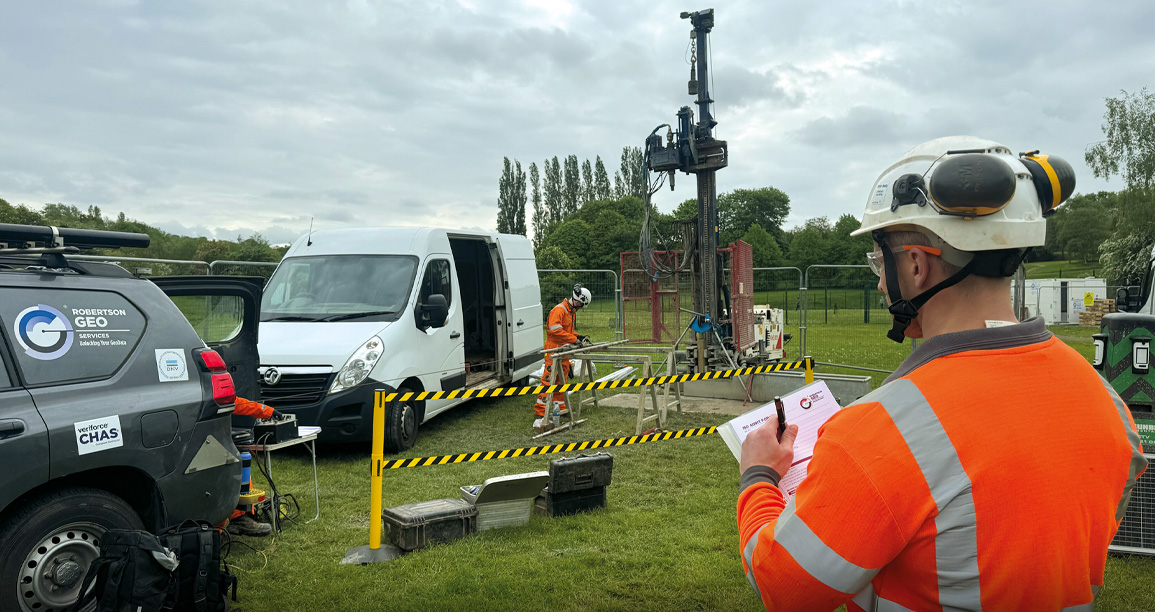
Due to concerns regarding borehole stability in weaker intervals, casing was installed during drilling operations to maintain open holes and reduce the risk of collapse. Prior to logging, the casing was carefully withdrawn to allow direct access to the borehole wall and to obtain higher quality geophysical data. Pulling the casing also helped reduce the risk of collapse occurring around the probes during data acquisition.
The geophysical survey utilised a combination of our 3-Arm Caliper, High Resolution Optical Televiewer (Hi-OPTV)® and High Resolution Acoustic Televiewer (HRAT)®. A Robertson Geo Sheave Wheel and rig set-up was used to support the safe and controlled deployment of the probes throughout the logging programme. The combination of tools allowed both borehole geometry and structural information to be collected in detail across the full depth of the investigation.
Borehole conditions presented several operational challenges during the works. Muddy water within the boreholes significantly reduced visibility for the High Resolution Optical Televiewer (Hi-OPTV)®, limiting image clarity in some intervals. As a result, the High Resolution Acoustic Televiewer (HRAT)® became particularly valuable, as it could produce consistent structural imagery despite the poor water conditions. The caliper probe additionally provided important information relating to borehole diameter changes and potential instability zones and fractures.
One of the most significant geological features identified during the investigation was a coal seam encountered between approximately 14m and 16m depth. Geophysical responses indicated that this interval consisted of semi-competent ground relative to the surrounding strata. Variations in borehole diameter and changes in televiewer response across this interval helped distinguish the coal-bearing section from adjacent geological units.
Throughout the project, careful management of borehole conditions and logging operations was required to ensure successful data acquisition. The combination of unstable ground, casing removal, and reduced optical visibility created challenging working conditions, however the use of complementary logging techniques ensured that reliable data could still be collected across the boreholes.
RGS management also took advantage of the amenable site conditions to conduct a site audit, as required biannually for ISO 9001 compliance.


