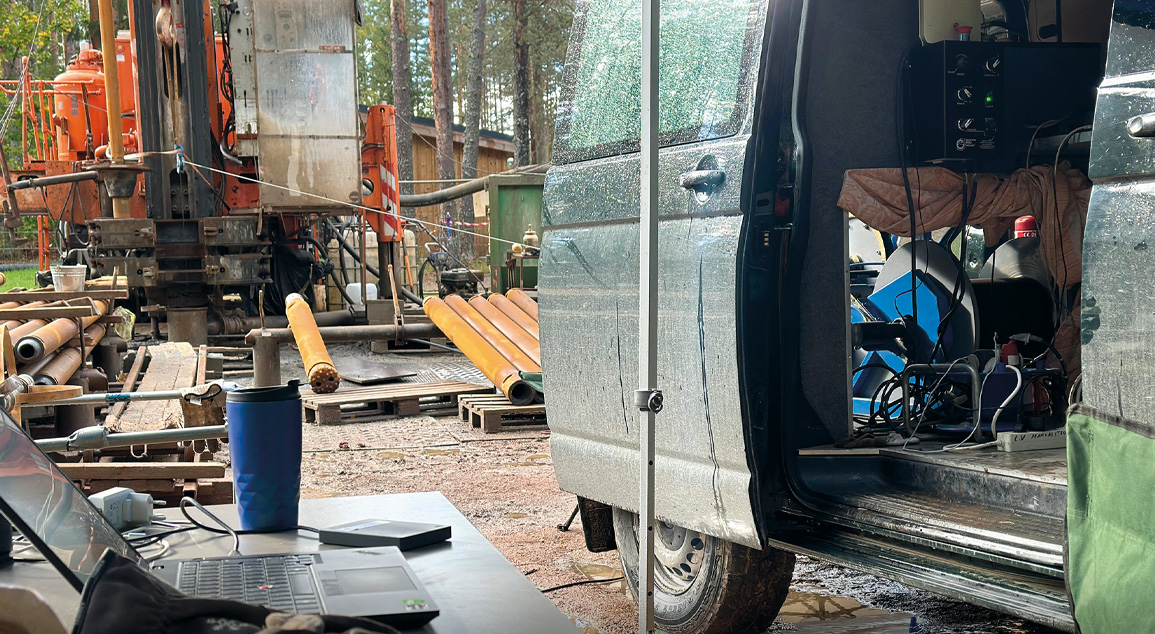
The project was initiated by the Ministry of Climate to evaluate the feasibility of medium-deep (500–700m) geothermal systems for space heating and cooling in Estonia. The project focuses on residential apartment buildings, municipal facilities, and storage complexes using ground source heat pump technology. Different types of geothermal borehole heat exchangers where applied, including U-tube, double U-tube and coaxial systems.
Drilling and geophysical investigations were conducted at three locations. A geophysical survey was required at each as cores were not to be collected. All boreholes were drilled by Engineering Bureau Steiger using down–the-hole hammer and reverse circulation RC methods without core drilling. Consequently, a comprehensive geophysical logging program conducted by GSE was essential for subsurface characterisation. At each location drill chips were collected with 3-6m intervals for subsequent analysis of rock geochemistry (XRF, XRD) and thermal conductivity.
The three locations investigated were Tallinn region Taludevahe, central Estonia Roosna-Alliku and East-Estonia Arbavere at the GSE field camp and core storage facility. The objectives of the logging were to determine bottom-hole temperatures within crystalline basement rocks, assess groundwater properties in the uncased sections, and characterise the sedimentary overburden. Natural gamma measurements supported lithological interpretation and identification of boundary depths.
Special attention was given to the cementing of the deep section of the Arbavere coaxial borehole to ensure watertightness and hydraulic isolation. For that purpose, optical and acoustic televiewer logs, together with fluid conductivity and heat pulse flowmeter measurements were used to identify fracture networks and potential inflow or outflow zones within the crystalline basement, comprising granites, amphibolites, and biotite gneisses. This data guided the placement of cement to mitigate vertical fluid migration and reduce hydrogeological risks to upper aquifers. Especially in Arbavere, borehole logging was performed at multiple stages to characterise geological and hydrogeological conditions, assess fracture filling in crystalline rocks, and identify fluid flow near the fractured zones.
Overall, the GEOENEST project demonstrates how integrated drilling, logging, and engineering workflows can reduce uncertainty and support the safe deployment of deep geothermal systems in low-enthalpy crystalline settings.
High Resolution Optical Televiewer (Hi-OPTV)®
High Resolution Acoustic Televiewer (HRAT)®
3-Arm Caliper
Formation Density
Electric Log
Temperature Conductivity
Heat Pulse Flowmeter
Fluid-Gas Sampler


