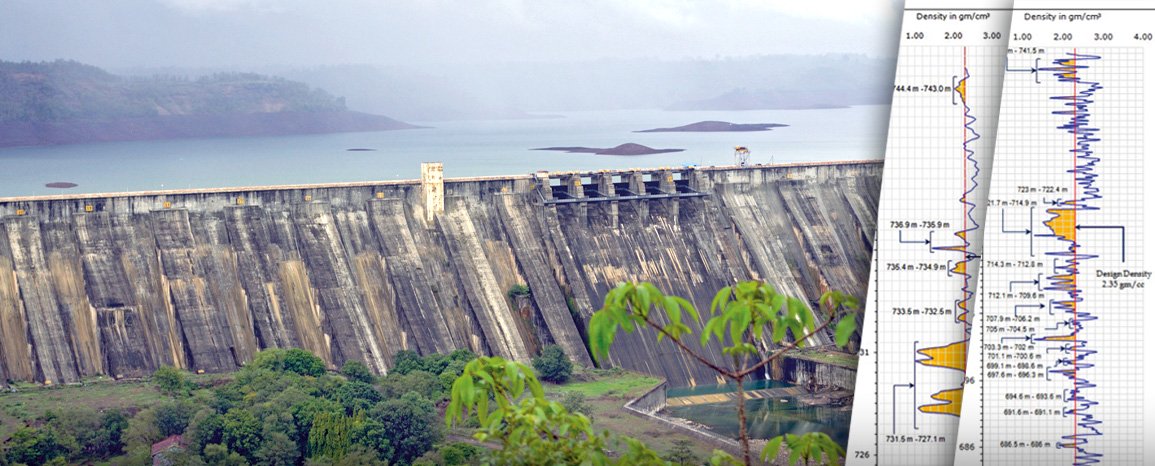
With over 45 years of expertise providing cost-effective solutions to many complex civil engineering problems and studies related to power projects, Isotope Hydrology were ideally placed to utilise their skills in tracer techniques and non-destructive borehole logging for the Dam Rehabilitation and Improvement Project (DRIP).
DRIP is a program focused on enhancing dam safety and performance in India. It aims to improve the structural and operational aspects of dams and strengthen the institutional framework for dam safety. India ranks 3rd globally with over 6,000 large dams, vital for ensuring the water security of the country. DRIP has completed rehabilitation of 223 dams under Phase I, with over 700 more scheduled in Phases II and III.
DRIP projects pertaining to dam safety and rehabilitation studies are being referred to the Isotope Hydrology division. Activities span many states in India, including Maharashtra, Jharkhand and Kolkata with studies undertaken and services provided for:
Foundation studies for dams, their allied structures and power plants: In-situ electrical resistivity, density, porosity and P and S wave velocity measurements to assess the strength of the subsurface formations for foundation studies.
Structural audit studies of hydraulic structures: In-situ density, porosity and P and S wave velocity measurements to diagnose the health of structures and assess the post remedial efficacy.
Detection of seepage in hydraulic Structures (dams and canals): In-situ density, porosity, borehole diameter variation measurements and tracer techniques applied for the detection of seepage.
The team use borehole logging methods to identify the sub-surface lithology and to detect weak zones by measuring different physical properties of the sub-surface formation. Typical logs include electrical resistivity (R), density (σ), porosity (Ф), P & S wave velocities and elastic properties (E & μ).
The division is equipped with a Robertson Geologging logging unit, which consists of a high speed data acquisition unit (Micrologger2), 500m Winch, software for acquisition and processing (Winlogger and GeoCAD®) and a suite of 10 probes which include Dual Neutron, 3-Arm Caliper, Full Waveform Sonic, Density Gamma, Electric Log, Formation Density, Focussed Electric (Guardlog), Neutron, High Resolution Acoustic Televiewer (HRAT)® and PS Logger®.
• Determination of in-situ bulk density of masonry by depth.
• Identification of low density weak zones in all boreholes with recommendations for remedial measures to strengthen the low density weak zones.
• Determination of in-situ mass density pertaining to each borehole location are important input parameters for structural safety reviews and for grout mix composition.
• Measurement of P and S wave velocities and density to determine elastic properties, used in stability analysis for strengthening of structures.


