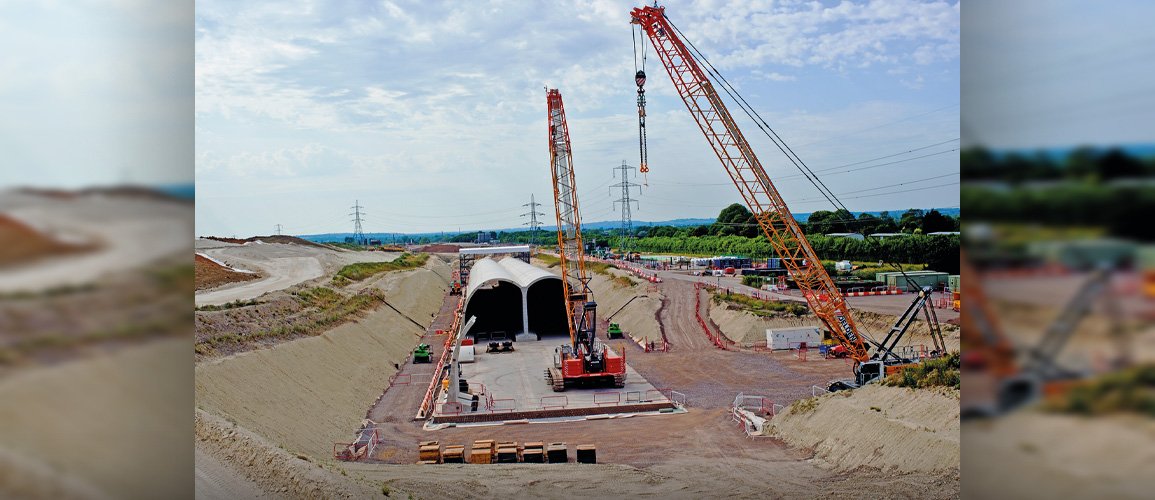
To ensure accurate ground characterization and safe construction, GK Drilling engaged Robertson Geo Services (RGS) to complete a detailed downhole investigation to assess the presence, size, and structure of any voids or anomalies.
To gain a clear insight into the borehole geometry and potential fractures or voids, RGS engineers used the following probes: High Resolution Optical Televiewer (Hi-OPTV)®, 3-Arm Caliper and Borehole Geometry.
The Hi-OPTV® provided a continuous, oriented 360° image of the borehole wall using a high-resolution CCD camera. This allowed visual identification of features such as fractures, bedding planes and any discontinuities suggestive of a void or cavity. The Hi-OPTV® confirmed a visually anomalous zone at 16.40m, showing changes in lithology and dark zones consistent with open fractures or voids.
The 3-Arm Caliper recorded a significant diameter increase within the identified depth range. This supported the hypothesis of an open void or partially collapsed cavity. The Borehole Geometry with its two independent pairs of caliper arms confirmed this, highlighting the differences in the diameter of the opening in both the X and Y axis. These findings suggested the presence of a natural dissolution void or a collapse feature within the chalk or weak marl formation typical of the Chilterns geology.
Robertson Geo’s high-resolution geophysical logging probes provided a robust and detailed understanding of a critical subsurface anomaly at the site. The integration of the three probe technologies demonstrated the value of a multi-sensor approach when managing geotechnical uncertainty for major infrastructure projects.


