One of the most common methods for acquiring this data is the Seismic Cone Penetration Test (SCPT) system, valued for its ease of use and cost-effectiveness. While the SCPT system is highly versatile and widely used, it does have limitations – particularly in terms of accuracy and penetration through stiff subsurface materials.
In Situ Engineering, based in Snohomish, Washington State, USA, were often asked by clients how PS Logger® data compared to SCPT results. Although the PS Logger® has been available since 1979, many geotechnical engineers and design firms have had limited exposure to it, and few have conducted side-by-side comparisons using both systems on the same project.
An opportunity arose for In Situ Engineering to do a comparative study. On a project in southern Idaho, SCPT testing was performed at two locations. After completing those tests, a drill rig was positioned over the same sites and used mud rotary techniques to drill open boreholes down to the same depths for PS Logger® testing.
Because both testing methods were conducted in identical materials, at the same time, and under consistent environmental conditions, a high-level of confidence was achieved in the comparative data. A graph is provided illustrating the recorded S-wave velocities from both systems.
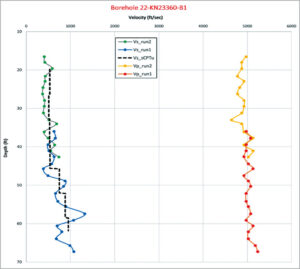
As shown in the graph, the PS Logger® data aligns closely with the averaged velocities obtained from the SCPT, with the PS Logger® trendline effectively bisecting the SCPT results.
This testing program allowed In Situ Engineering to inspire clients with strong confidence in the PS Logger® system as a reliable and accurate method for measuring both S-wave and P-wave velocities – especially in environments where SCPT deployment may be impractical.