Ghana has a rich history of gold mining going back centuries, with the early mining concentrating on recovering alluvial gold from streams. Starting in the 20th century modern mining techniques were employed to recover gold from quartz (QVT) and sulphide (DST) based deposits and production increased dramatically. Ghana is now Africa’s largest gold producer with gold representing 40% of the country’s total exports.
The project site was located adjacent to a working open cast mine. Work had already commenced looking to recover deeper ores from underground mining methods. This investigation was designed to gather information regarding the stratigraphy and fault networks in specific areas of interest, to build the best 3D mine model possible to assist with the planning of further underground development.
The probes required for the project were the Borehole Geometry, High Resolution Optical Televiewer (Hi-OPTV)®, High Resolution Acoustic Televiewer (HRAT)® and Full Waveform Triple Sonic. The two target boreholes had previously been core drilled to depths around 1,200m and were angled to provide the best information possible. Of particular interest was to delineate zones where aquifers may be present, which were important for understanding the gold mineralization history of the prospect.
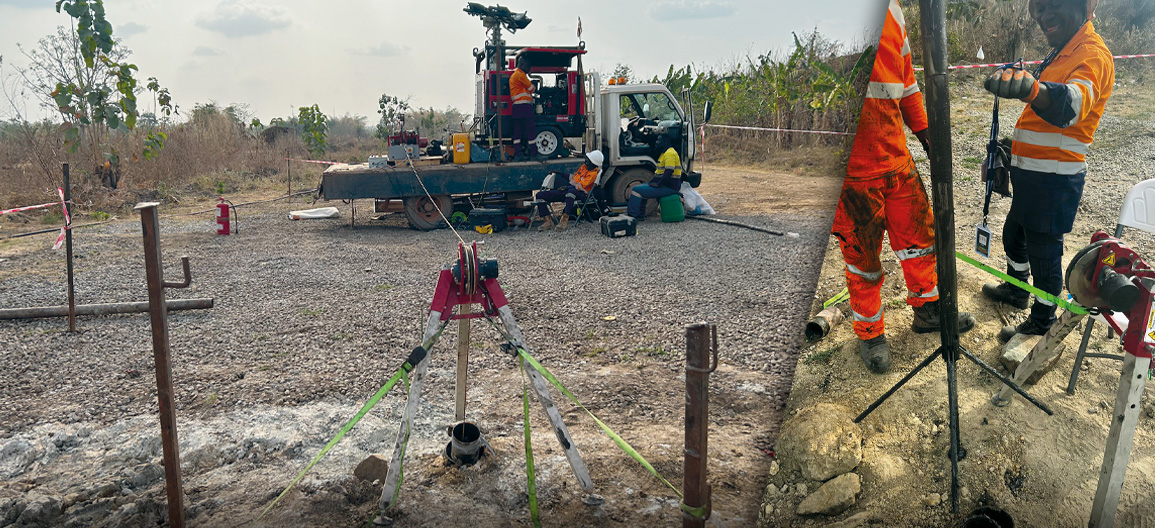
All the equipment was air freighted from the UK and the engineer was subsequently flown over to perform the logging. The equipment was fully checked by the engineer on arrival and the 2,000m Winch was securely mounted on to a flatbed truck, under the supervision of the engineer. The logging truck was then positioned over the two boreholes to facilitate the logging. The logging was conducted over a period of two weeks in challenging ambient temperatures up to 47°C.
The data produced by the Borehole Geometry probe was inclination and azimuth data together with caliper diameter data. The televiewer data delineated fractures and bed boundaries and could be used to orientate the core samples. From the full waveform sonic data, compressional (P) and shear (S) wave velocities were determined which can be used to calculate strength profiles of the formation.


