The shaft to be surveyed, known as Taylor’s Shaft, was constructed between 1921 and 1925 to provide water pumping for the East Pool Mine following an underground rockfall which caused flooding. Once the shaft was completed, a 90-inch pump known as Harvey’s Engine was installed and remained operational until 1954.
The pumping engine, manufactured in 1892 is one of the largest surviving Cornish beam engines in the world. Preserved in its towering engine house it serves as a reminder of Cornwall’s days as a world-famous centre of industrial engineering and innovation. The mine started out in the early 18th century producing copper ore, later producing tin, arsenic and wolframite before closing in 1945, eventually becoming part of the local World Heritage Site.
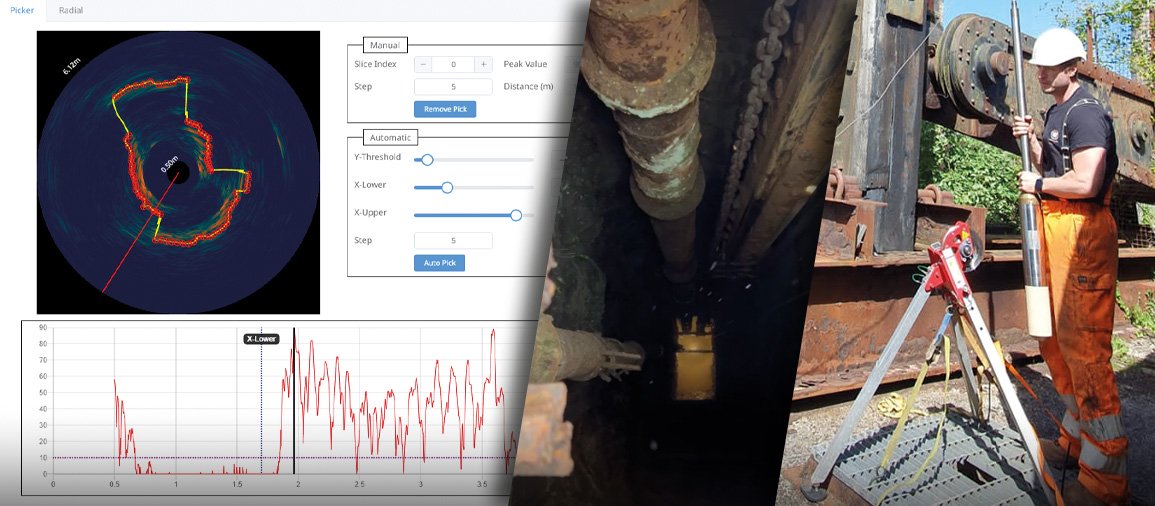
The Sonar Survey: The Sonar Caliper probe, developed and manufactured by Robertson Geo, is designed to provide a scaled and orientated cross-section of large bores, shafts, caverns and trench walls; combining accurate diameter measurements with a fully orientated 360° view of its surroundings.
The Sonar Caliper operates by emitting a pulse of sound that is reflected by a solid object; timing the delay between emission and the arrival of the reflected sound wave back at the probe to allow a calculation of distance to be made. The probe makes 400 individual radius measurements in a 360° arc around the probe and then orientates them to magnetic north.
The calibrated measurements were taken statically in the shaft at specific intervals and presented as cross sections. The cross-sectional data was then used to produce a 3D wireframe representation of the shaft.
The Video Camera Survey: When inspecting shafts, a video camera survey is usually a prime requirement. The video camera, with side and bottom view capability, can produce clear images both in air and underwater of the condition of the shaft walls and floor. The video obtained is recorded for subsequent detailed inspection. The recordings made form a permanent and legally binding record of the structural condition of the shaft.


